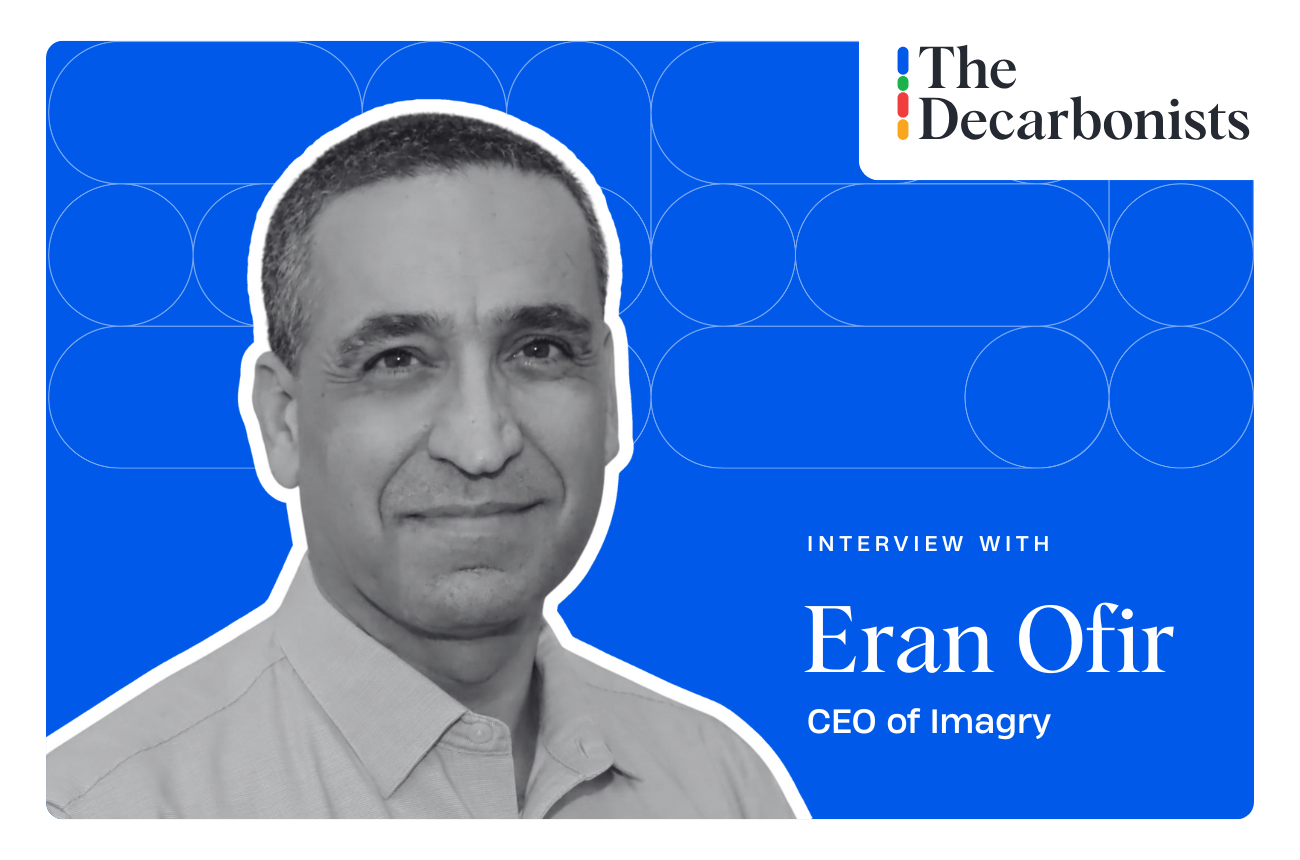

Ross: What is your professional background?
Eran: I am a computer engineer with three degrees from Tel Aviv University. I began my career developing software for B2B enterprises and had the opportunity to manage AOL Mobile for five and a half years, where I focused on delivering content for mobile platforms.
Following that, I joined Amdocs (a telecommunications company) overseeing operations in Africa and China. After building a smart grid billing business that was later acquired by NEC, I managed a cloud-based point of sale system for retailers, reaching 22,000 stores.
More recently, I developed a remote patient monitoring company, before taking on my current role, since 2021, as the CEO of Imagry.
Ross: Tell us about the opportunity that Imagry represents.
Eran: The automotive industry is experiencing a profound transformation. From 2020 to 2030, we anticipate a significant shift toward EVs, autonomous vehicles, and shared mobility. Our goal is to apply AI to the physical world, particularly in passenger vehicles and buses. But we believe the bus market is where there is greatest growth potential.
We began developing autonomous solutions in 2018, and since 2023 we have concentrated on large buses for PTOs in Europe, Japan, and the United States.
Ross: What drives that focus on buses?
Eran: There is a significant shortage of drivers—between 20% and 30% in many regions, approaching 40% in Japan. This shortage is expected to grow, given that younger people are less interested in being a bus driver, even though some cities, like Geneva, pay as much as €10,000 a month to drivers. The estimate is that by 2030, the market for self-driving buses will exceed $100 billion.
Ross: Who are your clients?
Eran: We are focused on traditional buses, operating on traditional routes. So, we partner with established bus manufacturers to provide solutions that meet the needs of PTOs across various regions.
Ross: Can you explain how those partnerships work?
Eran: We work closely with bus manufacturers to integrate our computing systems, cameras, and sensors into their existing buses. We have also established partnerships with major PTOs, such as Transdev, which manages a fleet of 70,000 buses across 21 countries. This collaboration allows us to effectively implement our autonomous bus solutions.
Ross: But the public transport market is generally low-margin. Could your tech transform the industry to a higher margin business?
Eran: Absolutely. By utilizing autonomous buses, operators can increase their efficiency without the heavy costs associated with driver salaries and Human Resource (HR) management. They can run more buses during peak hours, improving their top-line revenue by about 20%.The industry is transitioning from low margins toward becoming AI-driven industries, which will elevate their market value.
Ross: So you’re changing the operational model of public transportation.
Eran: Exactly. By working with established companies, we help them modernize without losing their existing operations.
Ross: How far along are you in the process of getting autonomous buses on the roads?
Eran: In Israel, we expect to deploy driverless buses in 2026. In Germany and Hungary, we anticipate the same timeframe, while in France, it could happen in 2027 as regulations continue to evolve.
Ross: So, we're looking at just a year or two until full deployment.
Eran: Yes. Once we secure the necessary permits, operators can order multiple buses for rollout.
Ross: What about public acceptance?
Eran: Public acceptance is crucial. We use a hybrid system: every second bus is autonomous, so passengers can choose a conventional bus if they prefer not to be driven by AI. But we foresee widespread adoption when people realize that driverless buses are safer.
Ross: Why are you focusing on buses and not robotaxis?
Eran: Many cities want to cut back on private cars: for sake of space, traffic reduction, emissions, utility, etc. Instead, they prioritize walking, cycling, and public transport, and autonomous buses offer excellent utility and emissions savings, enhancing the urban mobility experience. There are also in-between solutions: we recently signed our first European robo-shuttle contract for a fixed route.
Ross: Do you see this demand growing?
Eran: Yes. We’re experiencing significant demand for fixed-route shuttles, such as those connecting key locations like airports and train stations with city centers. This service can be efficiently managed using our technology.
Ross: The Economist recently put out an article (The self-driving taxi revolution is here), noting that self-driving vehicles cost $7-9 per mile to operate, compared to only $2-3 for traditional ride-hailers (including the driver). They cite a McKinsey report that says it will take ten years for self-driving vehicles to close this cost gap. What’s your solution for managing costs?
Eran: Our technology allows us to maintain lower unit economics—around $70,000 per vehicle—compared to competitors who often exceed $200,000 per vehicle, due to their reliance on expensive technologies like LiDAR and complex operational systems.
Ross: Is this because of your mapless technology?
Eran: Yes, by eliminating the need for complex mapping and additional sensors, we simplify the entire operational process, which enhances ROI. Also, because we operate as a white-label supplier we are able to partner with a variety of local manufacturers, making us flexible and responsive to regional needs.
Ross: And that’s an advantage over competitors like Waymo and Uber, who own their fleets?
Eran: Correct. Our approach supports local transportation companies, helping them transition to more autonomous systems while maintaining their operations.
Ross: It’s a sustainable and cooperative model, considering the regulatory environment in Europe.
Eran: Exactly. Local companies have longstanding relationships with municipalities, providing a path for modernization that doesn’t disrupt established operations.
Ross: Thank you for sharing your insights today, Eran.
Eran: Thank you, Ross. I appreciate the conversation and look forward to showcasing our developments at CES in January.
Ross: I’ll see you there.